
20 Products, Zero Plan? How to Build a Routine From What You Own
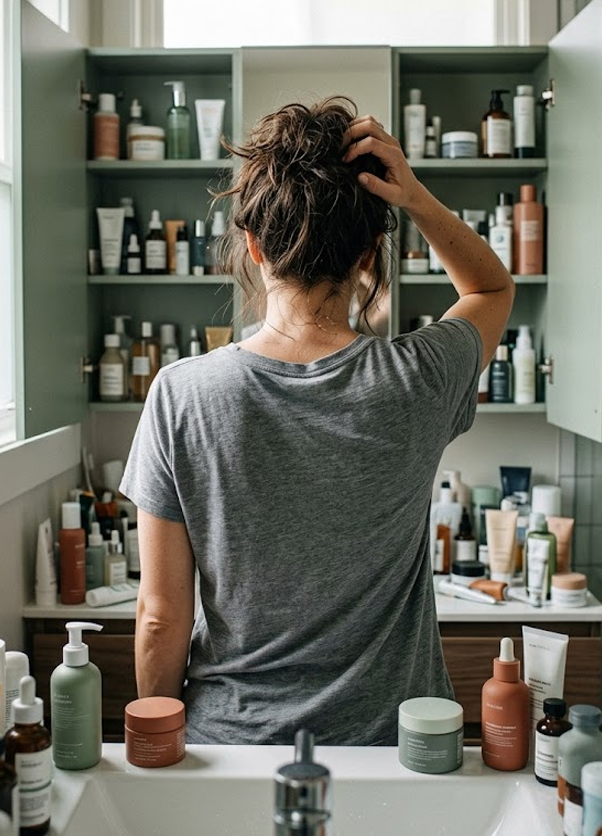
You own twenty products. You use three. The rest are basically décor. The good news: you almost certainly already have what you need — it just isn't organised into a routine yet.
TL;DR — Sort what you own into jobs (cleanse, treat, moisturise, protect), put them in the right order, and run a simple AM/PM routine. No shopping required.
Step 1: Lay everything out
Pull every product off the shelf and put it where you can see it. Bin anything that's expired, smells off, or has changed colour or texture. You'll instantly cut the pile down — and see what you're actually working with.
Step 2: Sort by job, not by brand
Group each product into one of these buckets:
- Cleanse — cleansers, micellar water, balms
- Treat — serums and actives (vitamin C, retinoids, exfoliating acids, niacinamide)
- Moisturise — creams, gels, lotions
- Protect — sunscreen (your one non-negotiable; see why SPF matters most)
If a product doesn't fit a job — or you have five things doing the same job — that's your clutter. Keep the one you actually like using.
Step 3: Put them in the right order
Order matters. The general rule is thinnest to thickest, with sunscreen always last in the morning.
Morning (AM)
- Cleanser (or water)
- Lightweight treatment, e.g. vitamin C
- Moisturiser
- SPF 30+
Evening (PM)
- Cleanser
- Treatment, e.g. a retinoid (a few nights a week)
- Moisturiser
Step 4: Don't let your actives fight
This is where most home routines go wrong. Don't stack a strong acid and a retinoid in the same session — alternate them on different nights instead. Full breakdown in retinol and acids: can you use them together?
A routine isn't about owning more — it's about using a few things in the right order, consistently.
Step 5: Keep it consistent for 4–6 weeks
Skincare is a slow game. Give a routine at least a month before judging it, and change one variable at a time so you can tell what's working. Resist the urge to buy a new "holy grail" every payday — more on that in how to tell if a serum is actually working.
Skincare routine order: the full layering guide
If you own more than the basics, here's the complete skincare routine order — apply thinnest to thickest so each layer can absorb:
- Cleanser
- Toner or essence (optional)
- Water-based serums / treatments (e.g. niacinamide, vitamin C)
- Eye cream (optional)
- Heavier treatments (e.g. retinoid at night)
- Moisturiser
- Face oil (optional, PM)
- Sunscreen — always last, mornings only
You won't use every step every day, and you don't need to. The order just tells you where a product goes if you use it.
A beginner skincare routine (the minimal starter)
New to this, or rebuilding after barrier damage? Start with the smallest routine that works and add from there:
- AM: gentle cleanser (or water) → moisturiser → SPF 30+
- PM: cleanser → moisturiser
Run that for two weeks. Once it's a habit, add a single treatment — a vitamin C in the morning or a low-strength retinoid a couple of nights a week — and build slowly. A simple routine you keep beats an advanced one you abandon.
Key takeaways
- You probably already own a complete routine — it's just disorganised.
- Sort by job: cleanse, treat, moisturise, protect.
- Order thinnest to thickest; SPF always last in the morning.
- Alternate clashing actives, and give it 4–6 weeks.
The shortcut
Doing this by hand means reading labels, remembering which actives clash, and sequencing everything yourself. That's the entire reason we're building Scangloo: scan your shelf, and it sorts your products into a clash-free AM/PM routine automatically — flagging the one thing you're actually missing.
References & further reading
- American Academy of Dermatology. How to apply sunscreen — SPF as the final morning step, applied generously.
- U.S. Food & Drug Administration. Alpha Hydroxy Acids — why exfoliating actives need careful timing and daily SPF.
FAQ
What order should I apply skincare?
Cleanser → toner (optional) → treatments/serums (thinnest first) → moisturiser → SPF (mornings). At night, drop the SPF.
Do I need to buy new products to have a good routine?
Usually not. Most people already own a cleanser, a moisturiser, treatments, and sometimes SPF. The fix is organising and sequencing them — not buying more.
How long before a routine "works"?
Give it 4–6 weeks. Cell turnover and visible change take time, so judge results monthly, not daily.
Let your shelf build the routine
Scangloo scans what you already own and turns it into a simple, clash-free AM/PM plan. Join the waitlist for early access.
Join the waitlist